


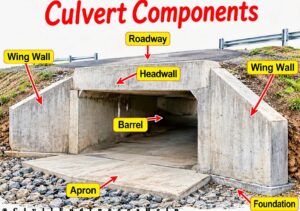
A culvert is a drainage structure constructed beneath roads, railways or embankments to allow water to flow from one side to another.
1. Roadway
The road surface constructed above the culvert to carry vehicle traffic safely.
2. Headwall
A concrete structure provided at the culvert entrance and exit to support the embankment and protect the opening.
3. Wing Wall
Side walls constructed at an angle to retain surrounding soil and guide water into and out of the culvert.
4. Barrel
The main passage through which water flows beneath the road.
5. Apron
A concrete or stone surface provided near the culvert inlet or outlet to prevent erosion and scour.
6. Foundation
The supporting base that transfers structural loads safely to the underlying soil.
7. Top Slab
The upper reinforced concrete slab that supports the soil fill and traffic loads above the culvert.
8. Side Wall
Vertical structural walls that support the top slab and transfer loads to the foundation.
9. Base Slab
The bottom concrete slab that supports the side walls and distributes loads to the foundation.
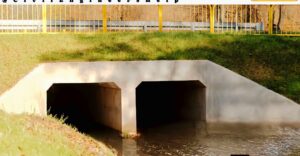
10. Central Pier
The vertical structural support separating two or more openings in a multi-cell box culvert.
11. Culvert Opening
The clear passage provided for water flow through the culvert.
Important Note: Proper structural design, foundation preparation, reinforcement detailing and drainage protection are essential for culvert durability.
Karibumedia.rw
