


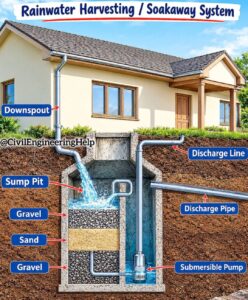
A rainwater harvesting system collects rainwater from the roof and directs it through pipes into a collection or drainage system. A soakaway allows water to infiltrate into the surrounding soil, helping reduce surface runoff.
Main Components and Functions:
1. Downspout: Carries rainwater from the roof gutter down toward the collection system;
2. Sump Pit: Receives and temporarily collects water before it is pumped or directed elsewhere.
3. Gravel Layer: Provides drainage space and allows water to flow through the surrounding aggregate;
4. Sand Layer: Can help filter certain suspended particles when properly designed as part of a suitable filtration system;
5. Discharge Line: Carries water away from the pit to an approved discharge or drainage location;
6. Discharge Pipe: Transports water from the sump or pump to the designated outlet;
7. Submersible Pump: Operates underwater to pump collected water out of the sump pit;
How It Works:
* Rain falls on the roof and enters the gutters.
* The downspout directs the water into the collection pit.
* Debris and sediment should be controlled using suitable screens and filtration.
* Water is either pumped through the discharge pipe or directed to a properly designed soakaway.
* In a soakaway, water gradually infiltrates into the surrounding soil.
Civil Engineering Tip: The image combines a sump pit and a gravel-and-sand infiltration section. These are related but distinct functions. A real installation needs proper sizing, soil infiltration testing, groundwater assessment, overflow provision and maintenance access. A submersible pump is needed only when water must be pumped rather than allowed to drain by gravity.
Karibumedia.rw
